
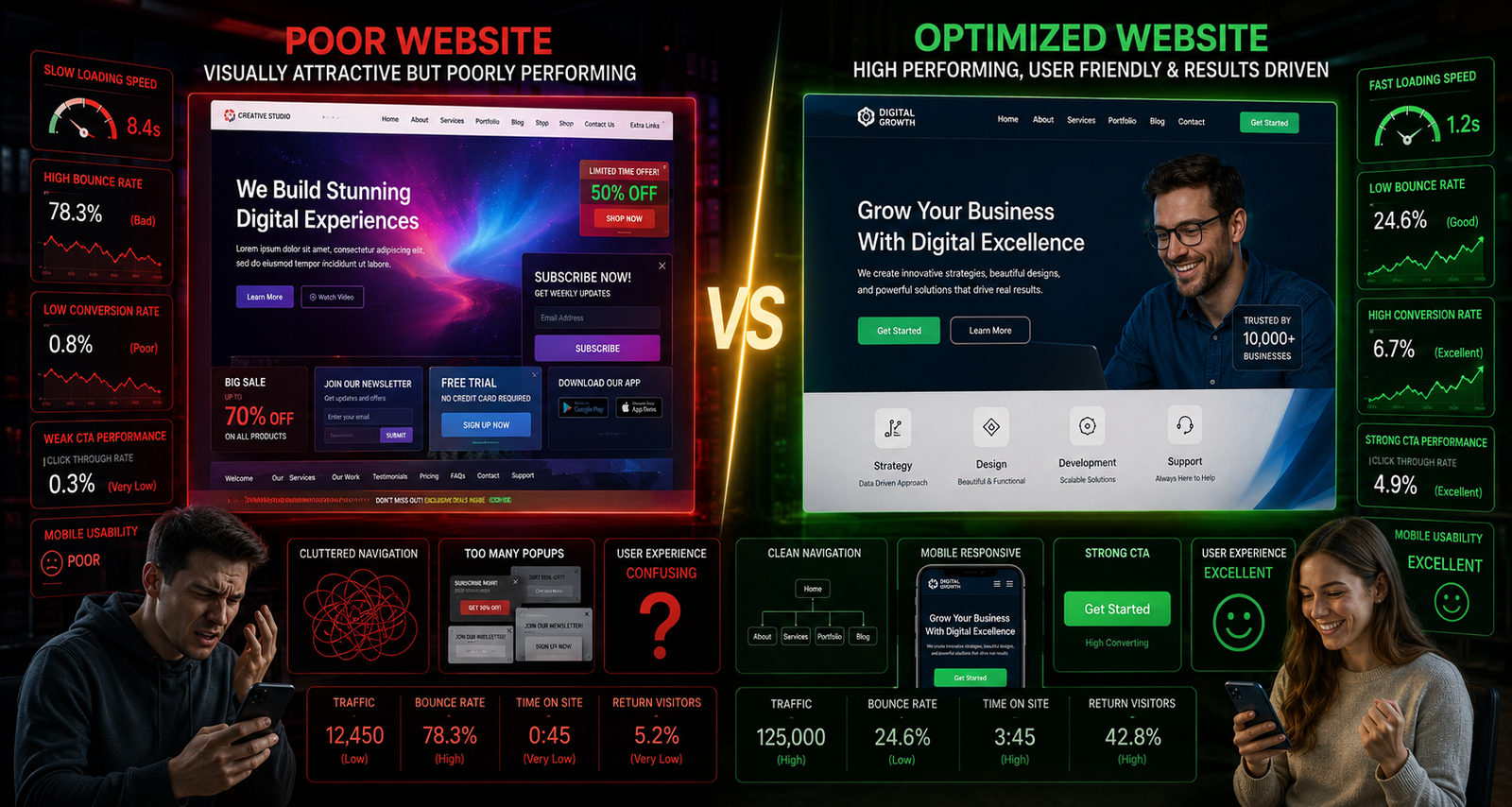
Why Most Websites Fail
Introduction
Many businesses believe a successful website simply needs:
• A beautiful design
• Fancy animations
• Premium colors
• Modern layouts
But the reality is very different.
Most websites fail not because they look bad —
they fail because they ignore how users actually behave.
A website can look visually stunning and still:
• Lose visitors
• Generate no leads
• Rank poorly on Google
• Frustrate users
• Fail to convert traffic into customers
Modern websites are no longer just digital brochures.
They are business tools.
And if they fail to guide users effectively, the entire business suffers.
The Biggest Misconception About Website Success
Design Alone Does Not Create Results
Many businesses spend heavily on visual design while ignoring performance and usability.
A website should not only look modern.
It should also:
• Load quickly
• Work smoothly on mobile devices
• Guide users clearly
• Build trust instantly
• Make actions easy
Because users do not visit websites to admire designs.
They visit websites to:
• Find information
• Solve problems
• Compare options
• Take action quickly
If the experience feels difficult, users leave immediately.
The Real Reasons Most Websites Fail
1. Weak Call-To-Action (CTA)
One of the most common website mistakes is unclear direction.
Many websites fail to tell users:
• What to do next
• Where to click
• How to contact
• How to purchase
• How to proceed
Without strong CTAs, visitors become passive observers instead of active customers.
Why CTAs Matter
A strong CTA helps users take action confidently.
Examples include:
• “Book a Free Consultation”
• “Get Started Today”
• “Request a Demo”
• “Contact Our Team”
Weak CTAs create confusion.
And confused users rarely convert.
Signs of Weak CTA Strategy
• Too many buttons competing for attention
• Generic text like “Submit”
• Hidden contact options
• No visual emphasis
• Lack of urgency or value proposition
Good websites guide users naturally toward conversion.
2. Poor Mobile Experience
Modern internet traffic is heavily mobile-driven.
Yet many websites still:
• Break on smaller screens
• Load slowly on mobile devices
• Use tiny text
• Have difficult navigation
• Create frustrating touch interactions
A poor mobile experience damages:
• User trust
• SEO performance
• Conversion rates
Google Prioritizes Mobile Experience
Search engines now evaluate websites using mobile-first indexing.
This means mobile usability directly affects:
• Rankings
• Visibility
• User engagement
If your website performs poorly on smartphones, your business loses opportunities daily.
Common Mobile Optimization Problems
• Non-responsive layouts
• Slow image loading
• Broken menus
• Popups covering content
• Buttons too small to tap
Users expect smooth mobile experiences instantly.
Anything less increases bounce rates dramatically.
3. Slow Loading Speed
Website speed is one of the most important performance factors today.
Modern users expect pages to load within seconds.
If your website feels slow:
• Users leave quickly
• SEO rankings drop
• Trust decreases
Even small delays impact conversions significantly.
Why Website Speed Matters
Fast websites create:
• Better user experience
• Higher engagement
• Improved SEO performance
• Stronger customer confidence
Slow websites create frustration immediately.
Most users will not wait for a slow website to load.
Especially when competitors are one click away.
Common Causes of Slow Websites
• Heavy images
• Poor hosting
• Excessive plugins
• Unoptimized code
• Weak caching systems
• Large animations
Performance optimization is no longer optional.
It is critical for business growth.
4. Confusing Navigation
A website should feel intuitive.
Users should instantly understand:
• Where they are
• What the business offers
• How to navigate
• How to contact the company
Confusing navigation creates frustration and increases drop-offs.
Simplicity Improves User Experience
The best websites prioritize clarity.
Good navigation systems:
• Use clear menus
• Organize content properly
• Reduce unnecessary complexity
• Keep important pages accessible
Users should never feel lost while browsing your website.
User Behavior Determines Website Success
Modern Users Scan, Not Read
Most users:
• Scan headlines quickly
• Judge websites within seconds
• Make fast decisions
This means websites must:
• Communicate clearly
• Highlight important information fast
• Reduce cognitive overload
A cluttered or confusing interface increases bounce rates rapidly.
Why Website Psychology Matters
Successful websites understand human behavior.
Users want:
• Simplicity
• Speed
• Trust
• Convenience
• Clarity
The best-performing websites are built around user psychology, not just visual trends.
SEO and User Experience Are Connected
Search engines increasingly prioritize websites that provide:
• Good usability
• Fast speed
• Mobile responsiveness
• Low bounce rates
• Clear structure
This means UX and SEO now work together.
A poor user experience negatively impacts:
• Rankings
• Traffic
• Engagement
• Conversions
Signs Your Website Is Underperforming
Warning Signals Businesses Ignore
• High bounce rates
• Low conversion rates
• Poor mobile engagement
• Slow loading pages
• Low average session time
• Declining organic traffic
These are often symptoms of deeper UX and performance problems.
How Successful Websites Perform Better
1. They Prioritize Clarity
Visitors instantly understand:
• What the business does
• Who it serves
• What action to take
2. They Load Fast
Performance optimization improves:
• SEO
• Engagement
• Customer satisfaction
3. They Focus on Mobile Users
Responsive design is now essential for modern businesses.
4. They Guide Users Strategically
Good websites reduce confusion and increase conversions naturally.
5. They Balance Design with Functionality
Beautiful design matters —
but usability matters more.
The best websites combine both effectively.
The Future of High-Performing Websites
Modern websites are evolving toward:
• Faster experiences
• Simpler interfaces
• AI-powered personalization
• Mobile-first design
• Conversion-focused layouts
Businesses that ignore these trends risk losing visibility and customers.
Conclusion
Most websites do not fail because of poor visuals.
They fail because they ignore:
• User behavior
• Website speed
• Navigation clarity
• Mobile usability
• Conversion strategy
A website should not just impress visitors visually.
It should help them:
• Understand quickly
• Navigate easily
• Trust the business
• Take action confidently
Because in today’s digital world:
A successful website is not defined by how it looks.
It is defined by how effectively it performs.
FAQ Section
Why do most websites fail?
Most websites fail because they focus only on design while ignoring user experience, loading speed, mobile responsiveness, navigation clarity, and conversion optimization.
Does website design alone guarantee success?
No. A visually attractive website without usability, speed, and clear functionality often performs poorly in SEO, engagement, and conversions.
Why is mobile experience important?
Most internet users now browse through smartphones. Poor mobile experience increases bounce rates and negatively affects SEO rankings and customer trust.
How does website speed affect business performance?
Slow websites reduce:
• User engagement
• SEO rankings
• Conversion rates
• Customer satisfaction
Fast websites improve overall business performance.
What is a strong call-to-action (CTA)?
A CTA guides users toward important actions like:
• Contacting your business
• Booking services
• Making purchases
• Submitting inquiries
Weak or unclear CTAs reduce conversions significantly.




Login to comment
To post a comment, you must be logged in. Please login. Login
Comments (0)